Skip to content

Cart

Your cart is empty

Developing original products

Do you have any of these concerns?

Developing original products

What is grain kon?

Konjac is attracting attention because it is rich in dietary fiber and calcium, and is very low in calories.
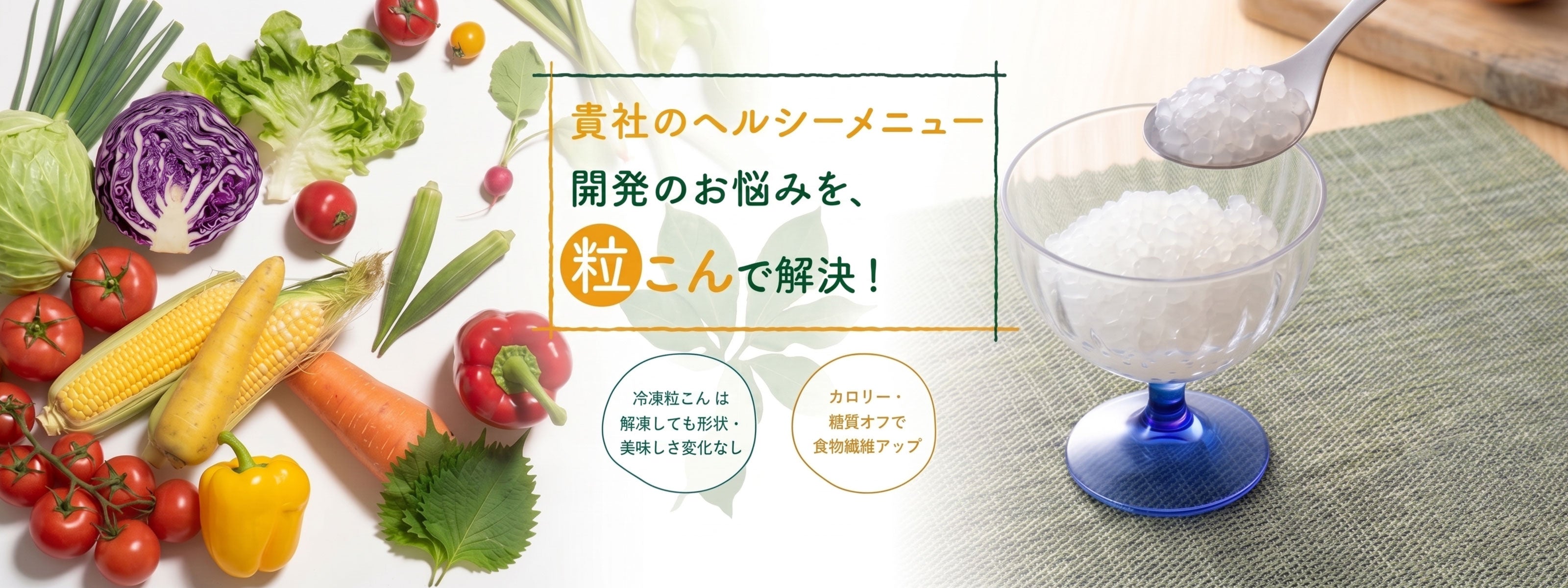
When this "konjac" is made into granules, it is called "granular konjac."
So, is it a nickname that's an abbreviation of "tsubu konnyaku" (granular konjac)? If you ask me that, it's not quite that.
"Grained Konjac" maintains the texture and shape that is lost when konjac is frozen and thawed, and also reduces the odor that is characteristic of konjac, making it suitable for a variety of cooking processes, including sweets. It is available in a wide range of sizes.
That's "Tsubu Kon" (granular konjac).
Frozen foods, which can be eaten easily, have become an indispensable food for busy modern people.
On the other hand, it is often avoided by health-conscious people because it is high in fat and carbohydrates, lacks dietary fiber and calcium, which are said to be lacking in modern people, and is high in calories.
In such cases, you can cut out calories and carbohydrates and supplement the nutrients that are said to be lacking in modern people. Konjac also has the advantage of being filling, so it can be used as a diet food or for menus with dietary restrictions.

Konjac that doesn't change shape even after thawing?

Konjac that doesn't change shape even after thawing?

Dedicated to konjac, with over 90 years of trusted experience.

By incorporating freeze-resistant starch, it is possible to manufacture konjac that retains its shape even after freezing and thawing.
It is made in the same way as konjac, but by using an exquisite blend of starches, it is possible to make it closer to the properties of starch, which makes it possible to freeze it.
It was developed from over 90 years of konjac manufacturing technology and experience.

Dedicated to konjac, with over 90 years of trusted experience.

Use

1

Use

The granules range in size from 2mm to 40mm.
Prototype production is possible starting from 25kg. Approximately 120 units (assuming 200g/bag).
We can accept orders starting from 50kg (approximately 250 bags).

2

Can be used as a substitute for rice.

Compared to 1kg of domestic rice (¥250~), it's roughly the same price. When used with rice, it makes a healthy rice with fewer calories and carbohydrates.

3

Wide range of packaging options

Packaging is possible in sizes ranging from large (2000g) to small (100g).

4

Safe and secure domestic production

Reliable domestic production using safe domestic ingredients

5

Can be colored

It is possible to color the konjac granules with naturally derived ingredients (some colors can be created, while others cannot).

6

Quality Assurance System

Metal detectors, X-ray inspection equipment, physicochemical testing, microbiological testing, and sensory testing are available. Organic JAS grading is possible.
HACCP certified factory

7

Shapes other than granules are also possible.

This cutting board can cut into over 20 different shapes, including not only thread but also cubes, twists, and triangles.

8

Contributing to health

It's low in calories at 20kcal per 100g, rich in dietary fiber, and contributes to good health. It has no unpleasant odor and can be used in any dish.

Examples of how to use granular konjac

Okonomiyaki

Okonomiyaki

By reducing the amount of wheat flour and adding whole konjac, we can reduce the calories by about 20%. Konjac has a high water-retaining capacity, so it bakes nicely.

Zoom

chinese dumpling

chinese dumpling

We've reduced the amount of ground pork and added whole konjac, so the delicious flavor remains the same, but the cost is reduced and the konjac's moisture retention makes it even juicier!

Zoom

hamburger

hamburger

The amount of minced pork and beef has been reduced and granulated corn has been added.
You can reduce calories by more than 20% and cut costs while still enjoying the same delicious taste.

Zoom

Grilled rice balls

Grilled rice balls

We've reduced the amount of rice and added konjac granules, which not only increases the calories but also reduces the carbohydrates. With a 1:1 ratio of rice to konjac granules, there's no problem!

Cha Han

Cha Han

We've reduced the amount of rice and added whole konjac, so it still has a flaky texture and is delicious, but also low in calories and sugar.