News List
- NEWS -

~ QUALITY MANAGEMENT ~

~ INGREDIENTS ~

For the original deliciousness of konjac
There are many cheap konjac products out there that are made only from konjac flour. Our company also uses konjac flour, but we also place great importance on the konjac yam.
Konjac root is a perennial corm belonging to the Araceae family, native to Southeast Asia.
Around 600 AD, it was introduced to Japan by Japanese envoys to the Sui Dynasty as a medicine with intestinal regulating properties.
Because konjac potatoes spoil easily and don't keep well, they were cultivated and consumed near Nara, the capital at the time.
Apparently, it was a luxury food that only people of high status could eat at the time.
Konjac became widespread throughout Japan during the mid-to-late Edo period (around 1776), thanks to the efforts of Mr. Toemon Nakajima of the Mito domain.
By drying the konjac yam and turning it into powder (1/10 the weight of the raw yam), the problem of it quickly spoiling and being difficult to transport or store over long distances was solved.
While this has made things more convenient, a significant portion of the potato's original flavor is lost during the process of processing it into flour.
Konjac potatoes are harvested once a year and, because they rot quickly once the soil is removed, they must be purchased in quantities of several tons at a time, washed, and frozen.
While this does incur costs such as transportation, labor, and freezing, we believe it is essential for producing delicious konjac.
We will continue to work hand in hand with farmers and use konjac potatoes with care.


~ HOW TO MAKE ~
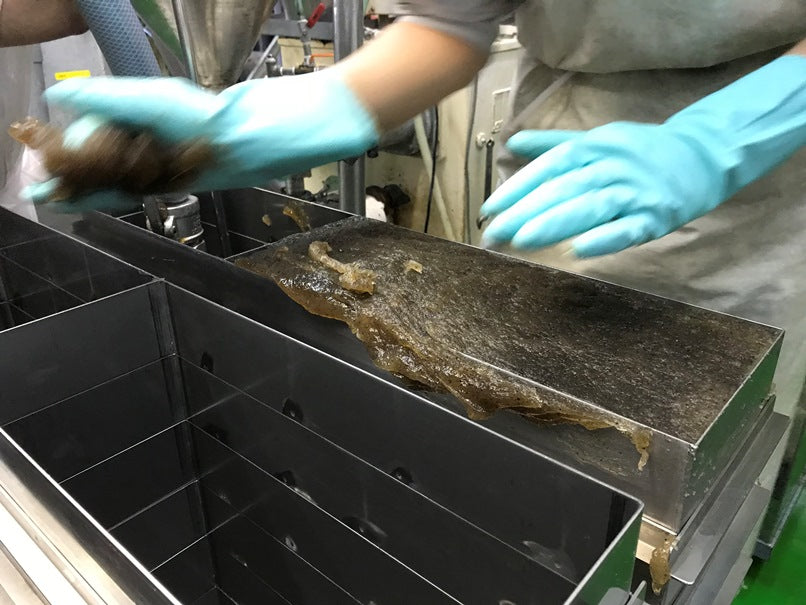
Why we continue to use traditional methods
There are several methods for making konnyaku sheets. They are becoming more and more convenient, with fewer steps, fewer people, and a shorter time required to mass-produce konnyaku of consistent quality.
Our "can steaming method" requires multiple steps and multiple machines and equipment, making it time-consuming and taking 2-3 days to complete.
But why do we continue to use this method? Because it's delicious.
The difference is so obvious when you taste it, no explanation needed, just because of the time and effort put into it.
It would be easy to mechanize the process and make it more convenient, but we continue to take the time and effort to produce this traditional "konnyaku" using the can-steaming method.


~ HOW TO MAKE ~
How is itokonnyaku made? I think many people don't know.
Our konnyaku noodles come out like a shower.
A plate with holes is attached to the end of the hose, and the konjac nori is pushed out like a shower and allowed to swim in hot water, where it is cooked and hardened.
This plate is called a "mezara" (strainer plate), and by changing the size and shape of the holes in it, a wide variety of konjac can be made.
Furthermore, this machine is also used to produce konjac in special shapes that are neither sheet konjac nor thread konjac.


~ HOW TO MAKE ~
Our tokoroten (agar jelly) is filled with the dedication and care of our third-generation owner, Koji.
First, the Tengusa grass, the raw material, is washed thoroughly four times, using a lot of water and effort. This thoroughly removes unpleasant odors and impurities.
One is boiling in a pressure cooker. While boiling in acid (vinegar) is common, we don't use this method because it adds an unnecessary acidity. We also use dry steam instead of live steam to prevent excess moisture from building up.
First, it undergoes a total of five filtration processes. By repeatedly rubbing the mixture through a variety of methods, from stainless steel mesh to fine cloth, it becomes smooth and prevents any residue of Amakusa from getting in.
Furthermore, we never compromise, constantly making minor changes to improve the taste after tasting it.
The tokoroten made in this way is so delicious that even people who didn't like tokoroten before will come to love it.
Our recommended "Nama Tokoroten" is made entirely from agar and water. The tokoroten concentrate is directly poured into a container and cooled to solidify, so it has a beautiful, yellowish-transparent appearance, with a clear taste and aroma.
The same goes for the noodle-shaped protruding pieces, and it's hard to tell where the water ends up. We use vinegar water as the preservative, but we use rice vinegar, which has a mild, pungent or strong smell, so it doesn't interfere with the sauce.


~ Facilities ~
Equipment name |
number |
Equipment details |
number |
Konjac steamed canning production line |
1 unit |
Storage tank 1,200L |
2 units |
Ito Konnyaku Production Line |
1 unit |
Storage tank 1,500L |
2 units |
Tokoroten Production Line |
1 Set |
Amakusa washing machine |
1 unit |
Taro Grinding Machine |
1 set |
Potato grater |
1 unit |
Vertical Form Fill Seal Machine |
4 units |
Vertical pillow continuous packaging machine |
2 units |
Horizontal pillow packaging machine |
2 units |
Horizontal pillow packaging machine |
2 units |
Cup Filling and Sealing Machine |
3 units |
88 square packaging machine |
1 unit |
Rotary vacuum machine |
1 unit |
||
Measuring instruments for the mini series |
1 unit |
||
boiling tank |
5 tanks |
||
cooling tank |
1 tank |
||
refrigerator |
1 room |
||
freezer |
2 rooms |
||
X-ray inspection equipment |
1 unit |
||
Weight checker |
1 unit |
||
metal detector |
4-5 units |
||
Rotary packaging machine |
1 unit |
