Skip to content

Cart

Your cart is empty

About Kikumatsu

~KIKUMATSU~

Thoughts on Kikumatsu

This konjac was developed by the third-generation owner, Koji, after much trial and error, as he strived to create an authentic product.
Then, taking the name from the founder, Kikumatsu Nakao, we named it "Kikumatsu Konnyaku."

The first generation founded the company, the second generation expanded it, the third generation refined the manufacturing technology, and the current representative, the fourth generation, is working diligently every day to spread it widely to the world.
We will continue to carefully manufacture this product so that it will remain a flagship product of our company and be loved by everyone for many years to come.

"I've never eaten konjac this delicious before."

Almost all customers who have tried Kikumatsu Konnyaku say the same thing.
Sometimes, people even say things like, "If you eat this, your palate will become so refined that you won't be able to eat any other kind of konjac."
We sometimes receive phone calls from individual customers in areas that our sales team doesn't reach, which surprises our employees.

The difference between this and regular konjac lies in the ingredients and manufacturing method, but both are done using traditional methods.
In today's world, where we have so many options, it makes you wonder how people in the past were able to use the most suitable raw materials.
Why does using "wood ash," which has been used since ancient times, make it taste so delicious?

How and why are they different?

"Kikumatsu's konjac can be eaten raw," they advertise.
This means that it has very little of the "odor" or "bitterness" that you typically find in konjac, and can be eaten as is after just rinsing it with water.

There are various reasons why Kikumatsu's konjac is of such high quality, including the raw materials and coagulants used.
All of these require effort, time, and manufacturing technology,
Through trial and error, we have established a system that allows for a stable supply.
I will explain some of these points with accompanying photos.

Thawing and mashing konjac root Thawing and mashing konjac root Thawing and mashing konjac root

Thawing and mashing konjac root

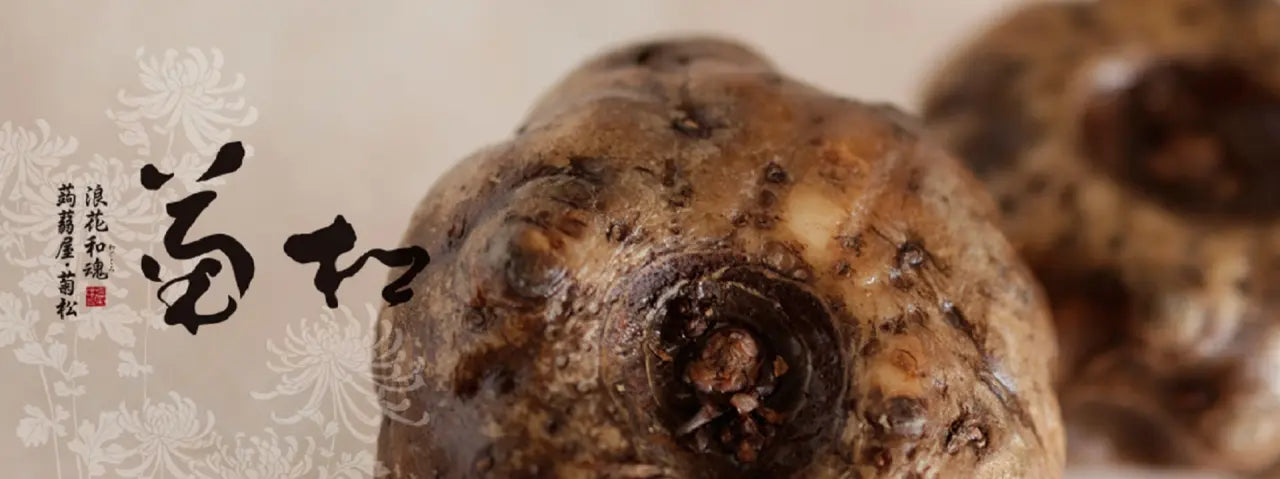
Kikumatsu Konnyaku uses absolutely no milled konnyaku flour, only organically grown konnyaku potatoes from Hiroshima Prefecture. Also, while steam is usually used to efficiently thaw raw potatoes, Kikumatsu Konnyaku is made differently. Frozen raw potatoes are placed in a tank and slowly thawed overnight using tap water. After that, the thawed raw potatoes are slowly ground up and mixed with water to make konnyaku paste.
Don't include unnecessary items. Don't include unnecessary items. Don't include unnecessary items.

Don't include unnecessary items.

Most commercially available konjac products have seaweed powder added to give them a brown or black color, or to create a texture resembling potato skin. This is because without it, the konjac would be pure white and wouldn't look like konjac. Even those labeled "raw potato" usually contain a blend of powders, including seaweed powder. Kikumatsu konjac, however, is made by grinding the konjac potato with the skin on, so it contains the skin and has the natural color of konjac.
Ash production, lye water production Ash production, lye water production Ash production, lye water production

Ash production, lye water production

We don't use any slaked lime or anything like that. Instead, we use a mixture of lye water extracted from the supernatant of water in which wood ash has been dissolved, and lye water in which calcium made from burnt scallop shells has been dissolved as a supplement. The wood ash is made by burning pesticide-free thinned wood in-house, turning it into ash, sifting it, and refining it. The coagulant is what affects the shelf life of konjac, but unlike slaked lime, which is artificially refined and has stable quality, wood ash is a natural product, so there is variability. Amidst this, we went through a lot of trial and error until we were able to produce thousands of units of product while maintaining a consistent quality.
Special way to enjoy Special way to enjoy Special way to enjoy

Special way to enjoy

It doesn't require the usual blanching process. It's delicious in regular dishes like oden, but here are some ways to enjoy Kikumatsu konnyaku in a unique way. [Kikumatsu Konnyaku Sashimi] Dip thinly sliced ​​Kikumatsu konnyaku in wasabi soy sauce or ponzu sauce. ★Advanced variation: Top with a mixture of shiso leaves and grated daikon radish, and drizzle with dashi soy sauce for a good taste. [Kikumatsu Thread Salad] Mix Kikumatsu thread konnyaku with your favorite ingredients such as cucumber and ham, and dress with ponzu sauce. ★Advanced variation: Mix with shredded egg for a Chinese-style salad.

About the material

For example, the raw konjac is made from organically grown konjac potatoes cultivated over two to three years in fertile land in the mountains of Fuchu City, Hiroshima Prefecture, surrounded by nature. No artificial coagulants are used; the konjac is solidified using the power of wood ash and seashells. No effort or time is spared in allowing it to mature slowly. These are the opposite of prioritizing efficiency and low cost, but Kikumatsu believes they are essential conditions for konjac to be a delicious and safe food. This sentiment applies not only to konjac but also to tengusa, the main ingredient of tokoroten. We preserve the original texture, mouthfeel, and deliciousness of konjac, and while using that as a foundation, we constantly strive for new interpretations and experiments, and we are always exploring even greater "deliciousness" so that everyone can enjoy delicious konjac dishes with peace of mind. To achieve this, there are many hurdles to overcome, such as further learning, effort, and skill improvement, but with pride and aspirations as a konjac maker in our hearts, and with our customers' "delicious smiles" as our guide, we will continue to do our best as the fourth generation konjac maker, both now and in the future.

About the material

For example, the raw konjac is made from organically grown konjac potatoes cultivated over two to three years in fertile land in the mountains of Fuchu City, Hiroshima Prefecture, surrounded by nature. No artificial coagulants are used; the konjac is solidified using the power of wood ash and seashells. No effort or time is spared in allowing it to mature slowly. These are the opposite of prioritizing efficiency and low cost, but Kikumatsu believes they are essential conditions for konjac to be a delicious and safe food. This sentiment applies not only to konjac but also to tengusa, the main ingredient of tokoroten. We preserve the original texture, mouthfeel, and deliciousness of konjac, and while using that as a foundation, we constantly strive for new interpretations and experiments, and we are always exploring even greater "deliciousness" so that everyone can enjoy delicious konjac dishes with peace of mind. To achieve this, there are many hurdles to overcome, such as further learning, effort, and skill improvement, but with pride and aspirations as a konjac maker in our hearts, and with our customers' "delicious smiles" as our guide, we will continue to do our best as the fourth generation konjac maker, both now and in the future.

Kikumatsu's thoughts

Kikumatsu regularly visits konjac fields in Hiroshima Prefecture.

As we drove higher and higher up the mountain, the sky seemed closer, and before we knew it, we arrived at a village surrounded by greenery on all sides.

We check on the konjac potatoes grown organically in the terraced fields nestled in the mountains, ensuring they are growing vigorously and healthily.

In order to create delicious and safe konjac that everyone can enjoy, it is essential that the ingredients are wholesome. This principle applies not only to the konjac potatoes but also to the wood ash and water used in Kikumatsu's commitment to reliable craftsmanship.

The smiles of the konjac farmers saying, "They're growing well again this year!" are the smiles of Kikumatsu, who has been passed the baton, and we face our konjac every day with the dream that it will bring even more smiles to our customers' dinner tables.